

Surprising as it sounds: owning a privacy-capable wallet does not automatically make your crypto use private. In practice, the difference between a casual wallet and a privacy-first wallet is operational and architectural — not just marketing. For US-based users who care about plausible deniability, network separation, and giving custody to themselves rather than a service, the right wallet is both tool and tactic. This piece breaks down how modern wallets that support Monero (XMR), Bitcoin (BTC), and other chains actually protect privacy, where the protections end, and how built-in exchange features change the threat model.
The immediate takeaway: a wallet that bundles Monero native features (subaddresses, private view key protections, background sync) with network anonymity (Tor/I2P and custom node support), hardware integration, and non-custodial design materially lowers several common deanonymization risks — but it cannot eliminate them all. I’ll explain the mechanisms, point out the failure modes, and give practical heuristics a privacy-conscious user can apply daily.
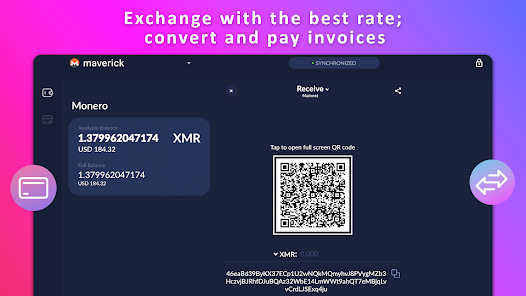
How the main privacy mechanisms work (and why they matter)
Start with Monero: its privacy is protocol-level. Ring signatures, stealth addresses, and RingCT obscure sender, recipient, and amounts. But a wallet is the gateway. Two wallet behaviors change how well those protocol guarantees hold in practice.
First, local key management. A truly non-custodial wallet keeps private keys — and in Monero’s case the private view key — on the user’s device only. That prevents server-side data collection and reduces a large class of supply-side risks. Second, network anonymity. If your wallet leaks the IP address associated with an address lookup or block fetch, you open a correlation vector. Wallets that offer Tor-only mode, I2P proxy support, and the option to use user-selected nodes actively reduce that exposure. Both architectural choices are necessary: protocol privacy without network protection leaves a gap; network protection without strong local key custody leaves another.
For Bitcoin and other UTXO chains, wallets mitigate linkage through coin control, PayJoin v2, Silent Payments, and batching. These are not as opaque as Monero’s rings, so the wallet’s UX and coin-selection policies materially influence privacy outcomes. For example, PayJoin reduces the traceability of a payment by creating a collaborative transaction — but it requires counterparty support and careful coin selection to avoid creating new linkages.
Built-in exchange, NEAR Intents, and privacy trade-offs
Instant in-wallet swaps are invaluable convenience, but they introduce additional trade-offs. Decentralized routing via NEAR Intents automates order discovery across market makers and avoids a single centralized counterparty. That preserves some decentralization and reduces single-point surveillance. However, any swap requires liquidity paths and counterparty interactions; state required to perform a swap — routing metadata, offers, and settlement transactions — can become a vector for correlation if not carefully handled.
Practical implication: using an integrated swap often reduces on-chain stitching (fewer external steps) but can increase metadata exposure during the swap negotiation. A privacy-first user should weigh the convenience of an instant swap against the possibility that the swap counterparties, even when accessed via NEAR Intents, will learn transaction timing and amounts (or at least ranges). Where absolute opacity is required, consider offline or peer-to-peer trade channels combined with post-swap protocol-level privacy measures (e.g., Monero’s native privacy or Litecoin’s MWEB).
Security stack and real-world limits: device-level protections and hardware integration
Device-level encryption (Secure Enclave on iOS, TPM on Android) and local authentication are practical guards against physical compromise. When integrated properly, they prevent attackers who obtain a device from extracting keys easily. The next protective layer is hardware wallet integration: signing transactions on a separate secure element (Ledger or the air-gapped Cupcake approach) reduces the attack surface further, especially for desktop environments or less-trusted hosts.
But these protections are not panaceas. A stolen device with biometric unlocking or a weak PIN still risks key exposure. Malware that intercepts transaction details before signing can still manipulate UTXO selection or destination addresses. And hardware wallets shift trust from software to the vendor and the supply chain; open-source firmware and auditable manufacturing practices help, but they do not eliminate supply-chain compromises entirely.
Cross-chain privacy, coins with special rules, and migration pitfalls
Multi-currency convenience introduces special-case rules that users must know. For example, Zcash in this wallet enforces mandatory shielding for outgoing transactions: a safety-first default that prevents accidental transparent address leaks. Conversely, Zashi (an unrelated wallet) seed incompatibilities mean ZEC migration cannot be automatic — users must manually transfer funds to a newly created wallet because of differences in change-address handling. That sort of migration friction is common across ecosystems: the wallet’s UX can protect users, but it can also trap them when formats differ.
There are also chain-specific privacy features to evaluate. Litecoin’s MWEB support, when activated, adds a MimbleWimble privacy layer; for BTC, Silent Payments and PayJoin v2 are helpful but opt-in and dependent on ecosystem adoption. The practical rule: treat privacy features as modular tools — some are protocol-level (Monero), some are optional extensions (MWEB), some are UX-level (shielding defaults), and each has different threat models and interoperability costs.
Operational heuristics and a reusable decision framework
Here is a compact, practical framework you can apply to evaluate your daily choices:
1) Threat model first: Are you defending against casual onlookers, targeted chain-analytics firms, or legal seizure and subpoenas? The stronger the adversary, the more you need hardware isolation, air-gapped key handling, and strict network separation.
2) Minimize linkages: Use subaddresses (Monero) and unique receive addresses (UTXO chains). Avoid address reuse and prefer PayJoin or Silent Payments where available to break simple heuristics used by chain analytics.
3) Separate network and custody layers: Use Tor/I2P or a trusted remote node to hide IP-level links. Keep private keys off hosted services; integrate a hardware wallet if you store significant sums.
4) Treat swaps as metadata events: If privacy is priority, prefer decentralized routing that avoids centralized custody, but understand that any swap negotiation can be a correlation point. When possible, break large position changes into staggered trades and use privacy-preserving destination chains (e.g., swapping into Monero when feasible).
What this wallet brings together and what still requires user discipline
By combining Monero-native privacy choices (subaddresses, local private view key protection, background sync) with Tor/I2P support, device encryption, hardware wallet hooks, mandatory ZEC shielding, MWEB for Litecoin, and zero telemetry, a modern privacy-first multi-currency wallet substantially raises the bar for passive surveillance. Integration with NEAR Intents for swaps reduces reliance on a single counterparty and makes in-wallet exchanges more defensible than naive centralized swaps.
Yet important limits remain: network-level defenses are only effective if used (Tor-only mode must be enabled); swaps still create metadata unless they are architected end-to-end with privacy in mind; device compromises and supply-chain attacks remain realistic threats; and interoperability quirks (like ZEC migration differences) can lead to user error unless documented and followed carefully.
Near-term signals to watch
For US users and others watching policy and tech trends, monitor three signals: wider adoption of collaborative transaction standards (e.g., PayJoin v2), which would help BTC privacy; improvements in decentralized swap routing that minimize reveal of timing/amounts; and any regulatory pressure that targets KYC at endpoints rather than on-chain transactions — because endpoint regulation changes the calculus of in-wallet swaps and hosted liquidity.
If collaborative standards gain traction and wallets improve default privacy UX (e.g., enabling shielded modes by default), privacy will incrementally improve across the board. If regulators force intermediaries to retain more metadata, endpoint privacy will become more important than ever.
FAQ
Q: Can I make Monero transactions completely unlinkable by using this wallet?
A: Monero’s protocol provides strong unlinkability at the transaction level, and the wallet’s features — private view key kept locally, subaddresses, and background sync — preserve that protection. Complete unlinkability also depends on network-layer hygiene (use Tor/I2P or trusted nodes) and operational security (avoid address reuse and metadata leaks). So the wallet gives you the tools; the outcome depends on how you use them.
Q: Are in-wallet swaps riskier for privacy than external exchanges?
A: It depends. In-wallet decentralized routing (NEAR Intents) avoids a single counterparty and reduces surface area compared with a custodial exchange, but the swap negotiation produces metadata that could be correlated with on-chain events. External exchanges add custody risk and centralized data collection. The decision is a trade-off between custody, metadata exposure, and convenience.
Q: Should I use hardware wallets with a privacy-focused multi-currency app?
A: Yes, for balances that matter. Hardware signing removes keys from the host environment and mitigates many malware and device-theft scenarios. The trade-off is convenience, and the supply-chain risk of the hardware itself. Use audited devices, verify firmware, and consider air-gapped signing for the highest-risk cases.
Q: What mistakes do US users often make with privacy wallets?
A: Common errors include leaving network privacy disabled, using linked accounts or services that force KYC, reusing addresses, and relying on integrated swaps without understanding counterparty metadata. Also, assuming “zero telemetry” means invisibility — zero telemetry reduces developer-side tracking, but it doesn’t hide on-chain signals or endpoint leaks.
For readers who want to evaluate a wallet concretely, inspect its defaults: does it enable shielding or privacy features by default, does it offer network anonymity options, does it keep keys locally, and can it integrate with hardware signing? These are practical litmus tests. If you want a place to start exploring a wallet that bundles these features with multi-chain convenience and decentralized swaps, consider investigating the options at cake wallet — but always test with small amounts first and align defaults with your threat model.