

What happens when a wallet shows you the full effect of a transaction before you sign it? That single design choice — making predicted token flows and fees explicit — reframes what a “secure wallet” means for a DeFi power user. Rabby, a non-custodial, multi-chain wallet created by DeBank, builds much of its identity around pre-transaction simulation and risk scanning. Those features are not mere polish: they rearrange the decision space for traders, liquidity providers, and teams managing multi-sig exposures. But simulation is not a silver bullet. Understanding how it works, where it reduces risk, and where it leaves gaps will help you decide whether Rabby belongs in your browser or institutional stack.
In the US context — where regulatory visibility, custody concerns, and compliance workflows matter to professional traders and small institutions — a wallet’s integration choices (hardware support, multi-sig, and auditability) often carry weight equal to the product UX. Rabby targets that mix: browser extension for Chromium-family browsers, desktop and mobile clients, open-source code under MIT, and integrations with hardware wallets and enterprise custody tools. Below I unpack the mechanisms that make Rabby distinctive, compare the trade-offs, flag hard limits, and suggest how to use Rabby in risk-conscious DeFi workflows.
How Rabby changes the signing decision: transaction simulation and pre-scan mechanics
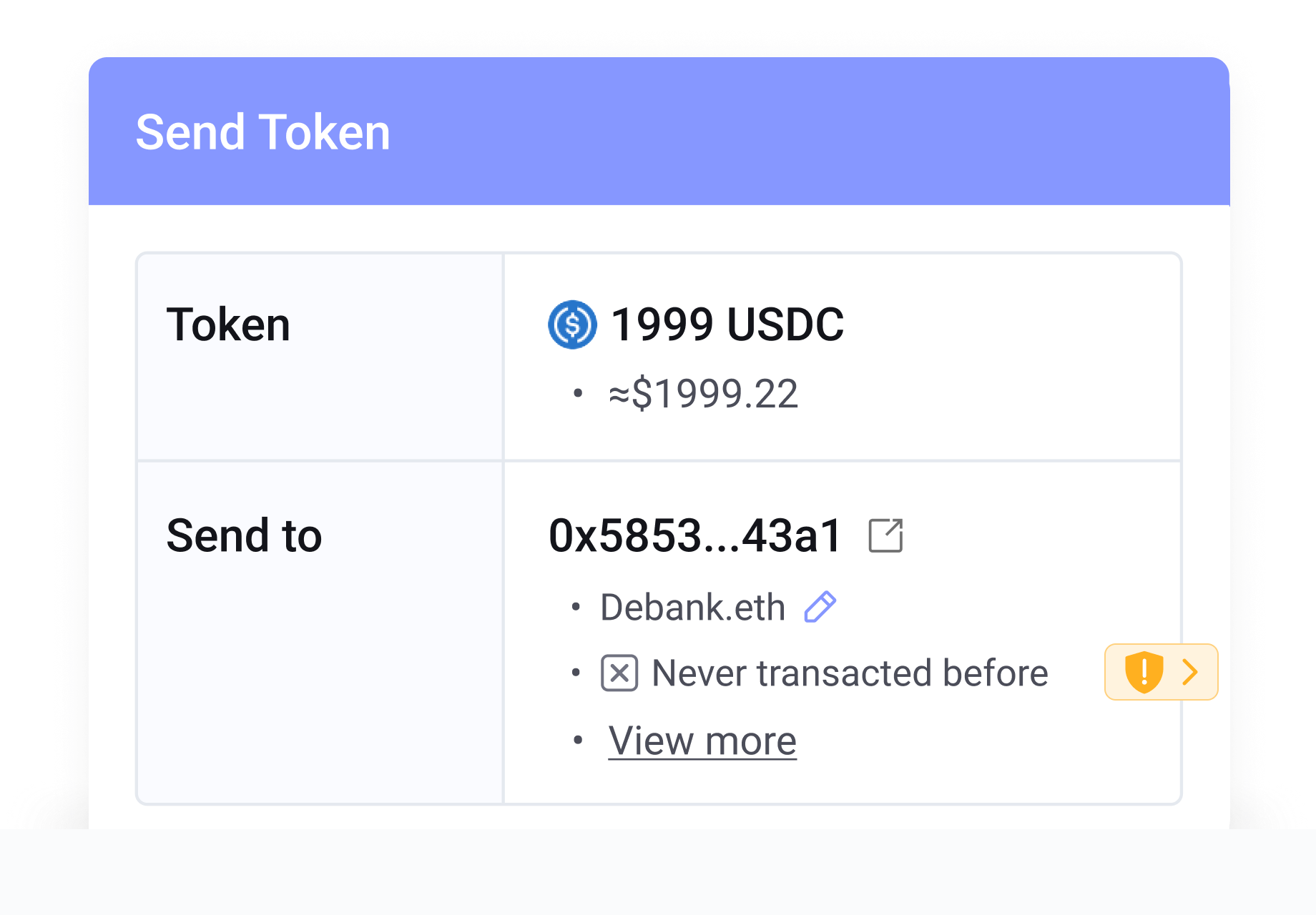
The practical difference between Rabby and many competitors is mechanism-first: before a transaction is passed to your key, Rabby performs an off-chain simulation of the call(s) the transaction will execute. That simulation computes estimated token balance changes (what you’ll receive or spend), gas usage, and how approvals or contract interactions will alter approvals and balances. It then renders those deltas in human-readable form so you can see, for example, “you will lose 1.23 ETH and receive 250 DAI; estimated gas 0.005 ETH.” Because it’s non-custodial, simulation runs locally using node RPC calls or backend helpers but crucially does not expose private keys.
On top of simulation, Rabby’s security engine executes a risk scan: it checks known-bad contract addresses (previously exploited contracts), looks for suspicious approval patterns (such as blanket infinite allowances), and verifies that recipient addresses exist on-chain. The interface combines these signals into alerts you can act on: cancel, revoke approvals, or proceed. That combination — simulation plus pre-scan — directly addresses “blind signing,” the practice of authorizing a transaction without understanding its on-chain effects.
Why those mechanisms matter for DeFi power users
DeFi power users run complex flows: zap contracts, multi-step swaps, liquidity migrations, or contract approvals performed by bots. For every extra step, the surface for error or malicious behavior increases. Transaction simulation converts a high-dimensional, opaque transaction into a compact, decision-useful summary. That allows a user or an ops team to do one of three things rapidly: proceed, adjust parameters (slippage, recipient), or refuse and investigate. It also lowers the cognitive cost of using unfamiliar dApps because the wallet explicitly shows outcome deltas rather than a raw hex payload or a vague gas estimate.
Rabby’s support for automatic network switching and cross-chain gas top-up further reduces operational friction. Automatic network switching means you no longer have to remember to toggle to Arbitrum, Optimism, or Polygon before interacting with a dApp — Rabby will detect the dApp’s chain and switch your wallet. Cross-chain gas top-up addresses a common failure mode for users who hold assets on one chain but need gas on another: instead of moving funds manually, you can top up gas tokens to the target chain, smoothing multi-chain workflows.
Trade-offs, limits, and real failure modes
No mechanism is perfect. Simulation relies on accurate state and predictable contract behavior. If the simulation uses stale RPC data or a contract incorporates non-deterministic logic (oracle-fed prices, time-dependent steps, or reentrancy with external calls), the predicted deltas can diverge from the final on-chain outcome. That means simulation reduces — but does not eliminate — risk. Users should interpret simulation as an informed forecast, not a guarantee.
Rabby also does not eliminate external sources of compromise. A browser environment can be attacked through compromised extensions, malicious web pages, or clipboard hijackers. This is why Rabby emphasizes hardware wallet compatibility (Ledger, Trezor, Keystone, CoolWallet, GridPlus, BitBox02) and integrates with multi-sig and custody services like Gnosis Safe and Fireblocks. For institutional or high-value accounts, pairing Rabby with hardware signing and multi-sig workflows is a practical mitigation: Rabby can show the simulation while the private signing step occurs on an isolated device or via a multi-sig threshold.
Another concrete limitation: Rabby currently lacks an in-wallet fiat on-ramp and native staking flows. For US users accustomed to buying crypto with a bank card inside an app, that absence is meaningful: acquiring assets requires an external on-ramp and subsequent on-chain transfer, which adds steps and potential AML/KYC friction if you’re attempting to fold those flows into a compliance-aware process. Similarly, if you want to stake directly from the wallet UI, you must use external staking dApps or custody integrations — again, a small operational tax for power users who prefer integrated flows.
Security history and what it signals
It is appropriate to be candid about past incidents. In 2022, a smart contract related to Rabby Swap was exploited, costing roughly $190,000. The team froze the contract, compensated users, and increased audits. That sequence matters for two reasons: first, it demonstrates that the Rabby team and community can respond operationally (freezing and remediation); second, it is a reminder that wallet ecosystems include a web of contracts and services that can introduce vulnerability even when the core wallet is secure. For risk-minded practitioners, the lesson is to separate wallet security (keys and signing UX) from broader protocol risk (contracts you interact with) and to use tools like approval revocation and per-contract limits to contain exposure.
Where Rabby fits in the wallet landscape — comparative trade-offs
Compared with mainstream alternatives (MetaMask, Trust Wallet, Coinbase Wallet), Rabby differentiates on pre-transaction simulation, automatic network switching, and a strong revocation tool. MetaMask is ubiquitous and integrated with a huge range of dApps, but historically it did not prioritize explicit outcome simulations in the same way. Coinbase Wallet ties into on-ramps and custodial rails, which is attractive for users seeking fiat rails but less desirable for those wanting complete non-custodial control. Rabby’s open-source MIT license supports third-party audits and community inspection — a positive for transparency — while its missing in-wallet fiat and staking features are deliberate trade-offs that keep the core UX focused on DeFi interactions and security primitives.
For US-based teams, Rabby gains points for enterprise integrations: Fireblocks or Amber support can slot Rabby into institutional flows where custody and compliance matter. If your priority is a single app that handles both retail fiat acquisition and simple custody, Rabby might feel slightly more modular than integrated. If your priority is deterministic previews of complex DeFi transactions and tight control over approvals, Rabby’s simulation-first model is a strong fit.
Decision heuristics — when to use Rabby and how to configure it
Here are practical heuristics you can apply when deciding whether to adopt Rabby in a US-based DeFi workflow:
- If your typical activity is executing multi-step DeFi strategies, use Rabby: the simulation and risk scan reduce cognitive load and surface common attack vectors (infinite approvals, odd recipient addresses).
- If you manage institutional funds, pair Rabby with hardware wallets and multi-sig (Gnosis Safe, Fireblocks) to keep signing trust-minimized while leveraging Rabby’s UX for pre-sign checks.
- If you need integrated fiat or native staking, plan to use external services for acquisition and staking; treat Rabby as the on-chain UX and security layer rather than an all-in-one consumer on-ramp.
- Enable approval revocation as routine housekeeping: limit contract allowances, revoke unused approvals, and use the revocation tool after high-risk interactions.
Those are simple rules, but they encode an important trade-off: security and clarity (simulation, revocation) versus convenience (in-wallet fiat, staking). Choosing Rabby means prioritizing the former.
What to watch next — conditional signals
Because there is no recent weekly project news in the current inputs, the near-term signals to monitor are structural rather than event-driven. Track three conditional indicators:
- Audit cadence and public bug bounty results: more frequent audits and active bounty payouts suggest a security-forward posture and rapid hardening of attack surfaces.
- Integration depth with custody and compliance tools: additional enterprise integrations would signal Rabby leaning further into institutional adoption in the US market.
- Feature expansion into fiat rails or staking: if Rabby introduces native on-ramps, reassess the security model and the trade-offs introduced by added third-party providers and KYC obligations.
Each of these developments would change the calculus for different user segments. For now, Rabby’s core signals point to a wallet optimized for non-custodial DeFi interactions with a bias toward explicit risk reduction.
FAQ
Does Rabby prevent all smart contract exploits or scams?
No. Rabby’s transaction simulation and pre-scan reduce the risk of blind signing and flag known-bad contracts, suspicious approvals, and non-existent recipients, but they cannot prevent novel contract-level vulnerabilities, oracle manipulation, or external hacks on dApps. Simulation is an informed forecast, not a guarantee. Use hardware wallets, multi-sig, and careful due diligence as complementary protections.
Can Rabby replace my hardware wallet or custody provider?
Not if you are managing significant assets in the US or need institutional control. Rabby integrates well with hardware devices and custody solutions — that is the intended model: Rabby as a UX and risk-screening layer, plus hardware or multi-sig for signing authority. For high-value or regulated custody, combine Rabby with established custodians like Fireblocks or multi-sig services such as Gnosis Safe.
How does Rabby handle multi-chain portfolios?
Rabby aggregates tokens, NFTs, and DeFi positions across more than 90 EVM-compatible chains into a single dashboard, easing portfolio tracking for multi-chain strategies. Automatic network switching and cross-chain gas top-up reduce friction when moving between L1s and L2s, but cross-chain actions still incur standard bridging risks and on-chain fees.
Where can I install or learn more about the browser extension?
You can find installation and documentation resources for the rabby wallet extension linked from the developer and community pages; use those resources to verify current features and recommended security setups before importing keys.